
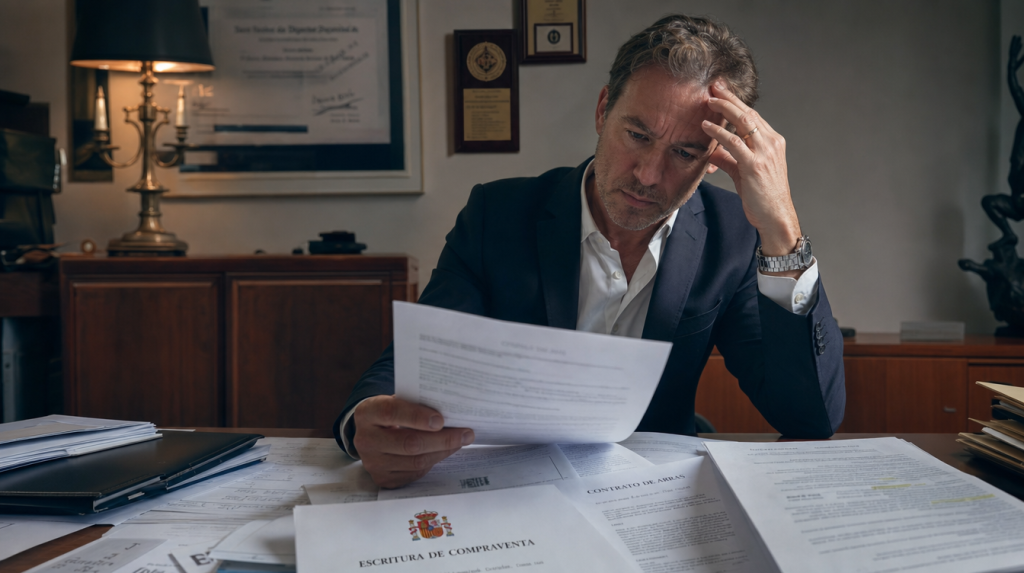
Buying property in Spain is one of the most significant financial decisions an international buyer will make. It is also one of the most legally complex — and the consequences of getting it wrong can be severe. Property defects, undisclosed debts, and planning irregularities do not disappear at completion. They transfer to the new owner.
This guide covers the most common — and most costly — mistakes international buyers make when purchasing property in Spain, and what a senior real estate lawyer does to prevent each one.
Mistake 1 — Not Hiring an Independent Lawyer
The most common and most costly mistake. Many international buyers assume the Spanish notary (notario) is acting in their interest. They are not. The notary's role is to authenticate the transaction and ensure it complies with Spanish law — they are a neutral party, not your legal representative.
The seller's agent works for the seller. The developer's lawyer works for the developer. Without your own independent legal representation, nobody at the table is protecting you.
What can go wrong: signing a Contrato de Arras without legal review, completing a purchase without proper due diligence, missing tax obligations, and discovering defects after completion that you are now legally responsible for.
The fix: hire a senior real estate lawyer before you make any financial commitment — including the reservation deposit. Legal fees of 1–1.5% of the purchase price are a fraction of what a single missed issue can cost.
Mistake 2 — Skipping Due Diligence
Spain has a significant problem with illegal constructions — unauthorized extensions, undeclared pools, buildings erected without planning permission. Estimates suggest that hundreds of thousands of properties across Spain have some form of construction irregularity, particularly on the Costa del Sol, Costa Blanca, and in rural areas.
The critical point: in Spain, these irregularities transfer to the new owner at the moment of completion. A demolition order on an unauthorized extension becomes your demolition order the moment you sign the deed.
Due diligence covers:
— Title verification — confirming the seller has clean legal title
— Debt check — mortgages, charges, and community fee arrears linked to the property
— Planning permissions — verifying all constructions are licensed and no orders are outstanding
— Cadastral records — confirming the registered description matches the physical property
— Community of owners — checking for unpaid fees and pending disputes
What can go wrong: buying a property with an illegal swimming pool subject to a €50,000 demolition order, or discovering after completion that the property has undisclosed debts that are now yours.
The fix: never sign the Contrato de Arras without a completed legal due diligence report from your lawyer.
Mistake 3 — Signing the Contrato de Arras Without Legal Review
The Contrato de Arras is the reservation contract that locks in the purchase price and timeline. It typically requires a 10% deposit. Most buyers treat it as a formality — it is not.
Once signed, the arras is legally binding. If you pull out as a buyer, you lose your deposit entirely. If the seller pulls out, they must return double the deposit. The terms, conditions, and protections written into this contract determine what happens if anything goes wrong before completion.
Common arras problems:
— No due diligence contingency clause
— meaning you cannot withdraw without penalty if your lawyer discovers a serious defect
— Unrealistic completion timelines that put you under pressure
— Clauses that waive your rights to certain legal remedies
— Missing protections for off-plan purchases against developer insolvency
What can go wrong: signing an arras on a property that your lawyer later discovers has an illegal extension — and losing your 10% deposit because the contract had no due diligence exit clause.
The fix: never sign an arras without your lawyer reviewing and if necessary negotiating the terms first. This is non-negotiable.
Mistake 4 — Underestimating the Total Cost of Purchase
International buyers consistently underestimate how much buying property in Spain actually costs. Unlike the US, where closing costs typically run 2–5% of the purchase price, Spain's total acquisition costs are significantly higher.
What you need to budget for on top of the purchase price:
— Transfer Tax (ITP) — 6–10% depending on the region, for resale properties
— VAT (IVA) + Stamp Duty (AJD) — 10% + 0.5–1.5% for new builds
— Notary fees — 0.2–0.5%
— Land Registry fees — 0.1–0.25%
— Legal fees — 1–1.5%
Total acquisition costs for a resale property: typically 10–13% of the purchase price.
Total acquisition costs for a new build: typically 12–15% of the purchase price.
For a €500,000 property, that means budgeting an additional €50,000–75,000 on top of the purchase price. For US buyers, these costs are generally not deductible in the same way as US closing costs.
What can go wrong: securing financing for the purchase price but not having sufficient funds to cover taxes and fees — which can delay or collapse the transaction at completion.
The fix: request a full cost breakdown from your lawyer before signing anything.
Mistake 5 — Buying Without a NIE
The NIE (Número de Identificación de Extranjero) is Spain's tax identification number for foreigners. Without it, no property transaction can proceed — it is required by the notary to sign the final deed, by the bank to open an account, and by the tax authorities to pay purchase taxes.
The problem: many international buyers — particularly those purchasing from the US — leave the NIE application too late. Applying at a Spanish consulate in the US typically takes 4–8 weeks. If your completion date arrives before your NIE is processed, the transaction cannot close.
What can go wrong: losing your completion date and potentially your deposit because your NIE was not ready in time.
The fix: apply for your NIE as early as possible — ideally before you make an offer. Alternatively, your lawyer can apply on your behalf in Spain using a Power of Attorney, which is typically faster.
Mistake 6 — Ignoring the Tax Implications
Buying property in Spain creates immediate and ongoing tax obligations that many international buyers discover too late — after completion, when they are already liable.
Taxes at purchase:
— ITP or IVA+AJD (covered above)
— Plusvalía municipal — a local tax on the increase in land value, typically paid by the seller but sometimes negotiated
Ongoing taxes as a non-resident property owner:
— IBI — annual municipal property tax, equivalent to US property taxes
— IRNR — non-resident income tax on deemed rental income, even if you do not rent the property. For non-EU owners (including Americans), the rate is 24% of 1.1% of the cadastral value annually
— Wealth Tax — applies to net assets in Spain above €700,000, varying by region from 0.2% to 3.5%
For US buyers specifically:
— FBAR — if your Spanish bank account exceeds $10,000 at any point, you must file FinCEN 114
— FATCA — if the property is held through a foreign entity, Form 8938 may be required
— Capital gains on the eventual sale are taxable in Spain at 19–26% for non-residents
What can go wrong: receiving a tax demand for years of unpaid IRNR that you did not know you owed, or facing IRS penalties for FBAR non-filing.
The fix: get a full tax briefing from your lawyer before completion — covering both Spanish and US obligations.
Mistake 7 — Buying Remotely Without the Right Legal Cover
A growing number of international buyers — particularly from the US — complete their Spanish property purchase without ever visiting Spain. This is entirely possible and legally valid through a Power of Attorney. But buying remotely without proper legal representation multiplies every risk on this list.
Remote buyers are particularly vulnerable to:
— Fraudulent listings — properties that do not exist, are not owned by the seller, or are misrepresented
— Pressure tactics — agents pushing you to sign quickly before you have had time for legal review
— Currency and transfer fraud — scammers intercepting payment instructions and diverting funds
— Missed site visits — physical defects that would be obvious in person but invisible from photos or video calls
What can go wrong: transferring a 10% deposit to a fraudulent seller, or completing on a property that looks nothing like the listing photographs.
The fix: appoint a trusted, independent lawyer before you make any financial commitment. Your lawyer should conduct all due diligence, review all contracts, and — if you are buying via Power of Attorney — sign the final deed on your behalf. Never transfer funds without your lawyer confirming the recipient account details independently.